
A purpose-built resist platform for low NA and high NA EUV Patterning
Irresistible Materials is focused exclusively on the development of next-generation EUV photoresists. Our work centers on solving the material-level challenges that now limit low NA and high NA EUV lithography as it increasingly gets adopted for high-volume manufacturing.
The key outcome of this effort is our patented Multi-Trigger Resist (MTR™) platform.
A novel resist designed to fully meet the requirements of today and tomorrow
Extreme ultraviolet lithography is increasingly limited by stochastic effects driven by sparse photon exposure, low depth-of-focus, and narrow process windows.
The Multi-Trigger mechanism used in MTR directly controls catalytic reactions based on local exposure, suppressing unwanted reactions while selectively accelerating desired chemical reactions to deliver cleaner, more reliable EUV patterning.
How the multi-trigger mechanism works
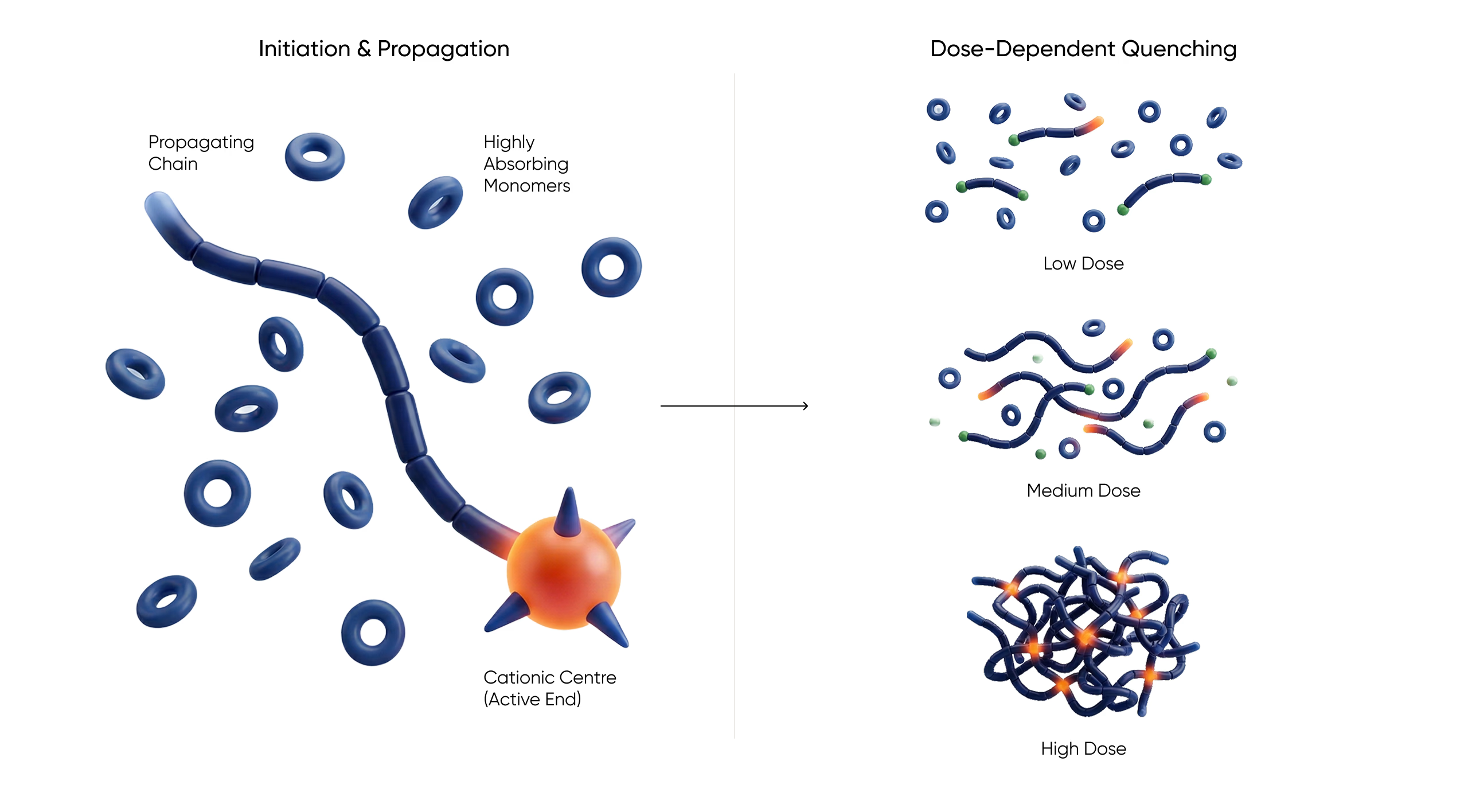
Exposure creates local initiators
EUV exposure generates initiators within the resist film, with high concentrations in exposed regions and low concentrations in unexposed regions.
Reactions are conditionally controlled
The resist formulation contains multiple functional elements that respond differently depending on local initiator concentration. In regions with low initiator levels, reactions are suppressed, preventing isolated activation events from forming features.
Desired reactions are selectively accelerated
In regions with sufficiently high initiator concentration, the same elements accelerate the crosslinking reaction, enabling efficient and well-defined pattern formation.
Noise is suppressed, signal is reinforced
By suppressing reactions in unexposed areas and reinforcing reactions in exposed areas, the multi-trigger mechanism converts stochastic exposure into a cleaner, more manufacturable signal.
The Multi Trigger Resist (MTR™) Platform: Overview
The Multi-Trigger Resist platform is implemented using a patented high absorption
small-molecule organic resist mechanism designed specifically for EUV lithography.
This material foundation enables precise control over exposure behavior while supporting high sensitivity, tunability, and compatibility with existing manufacturing equipment and processes.
Material characteristics

Organic small-molecule resist
Enables tighter control at EUV scale compared to polymer-based systems.

High EUV absorption (opacity)
Improves photon utilization in a sparse EUV exposure environment

Formulation-level tunability
Allows customization to optimize resolution, line roughness, and sensitivity tradeoffs for specific layers

High sensitivity exposure
Supports faster exposure and improved tool throughput

Metal-free and PFAS free
Designed to meet environmental, contamination, and integration requirements

Thin film etch resistance
High degree of etch durability with low top loss after development, enabling the etching of ultra thin resist films through the stack
EUV resist performance aligned with manufacturing realities
The MTR platform is highly tunable which enables the rapid development of customized resist formulations tailored to meet the specific customer needs.
MTR's molecular-level control directly enables the performance targets to be met for advanced manufacturing, where resolution, sensitivity, defectivity, yield, throughput, and process windows must all be optimized simultaneously.
Key Benefits
Fine resolution at tight pitches
Accurate patterning of very small features without edge degradation.
High sensitivity for lower cost of ownership
Faster exposure and improved EUV tool throughput.
Reduced stochastic defects and higher yield
Fewer bridging and missing features.
Large and stable process windows
Improved robustness across dose and focus variations.
Let's talk about your needs.
We stand ready to work with the entire semiconductor ecosystem of customers and partners who are interested in exploring our innovative resist material platform.